How to Choose a DMS Development Partner: 10 Non-Negotiable Technical Criteria
Posted on October 7, 2026

Quick Summary
Choosing a DMS development company requires evaluating more than software features and upfront costs. Dealerships should assess API documentation, uptime commitments, data portability, mobile usability, security, multi-branch scalability, integration architecture, disaster recovery, post-launch support, and the vendor’s development roadmap. The right dealer management system should connect dealership operations, protect business data, and adapt as the organization grows.
Short Insights: How to Choose a DMS Development Company
Choosing the right DMS development company helps dealer groups build a reliable technology foundation for sales, inventory, service, accounting, CRM, and multi-branch operations. Before selecting an auto dealer software vendor, evaluate these essential technical criteria:
- API documentation and integrations: Look for clear API documentation, supported integration methods, authentication details, and reliable data synchronization with accounting, CRM, manufacturer, payment, and other dealership systems.
- Uptime and disaster recovery: Require a written service-level agreement (SLA), clear incident-response procedures, documented backup policies, and defined recovery time and data-loss objectives.
- Data portability and ownership: Confirm that your dealership can export customer records, vehicle data, service history, transactions, and other business information in usable formats without unreasonable restrictions or fees.
- Mobile usability and security: Test how well the DMS works on mobile devices and assess role-based permissions, authentication, encryption, audit logs, and incident-response processes.
- Multi-branch scalability: Ensure the platform can support additional locations, users, vehicles, transactions, and historical records while maintaining centralized reporting and appropriate branch-level access.
- Reliable integration architecture: Check how the DMS handles failed integrations, duplicate records, synchronization errors, and connected-system updates to prevent disconnected data and repetitive manual work.
- Post-launch support: Establish clear support responsibilities, response times, software update arrangements, bug-fixing processes, and pricing for configuration changes and new development.
- A clear development roadmap: Choose a partner that can adapt the platform as dealership requirements, technology, integrations, and operational workflows evolve.
Choosing a dealership management system is not only a software buying decision. For a growing auto dealer group, it is a long-term technology decision that can affect sales, inventory, service, accounting, customer management, reporting, and daily operations across every branch. The wrong platform can create years of workarounds, while the right system can give a dealership a stronger foundation for growth.
This makes DMS development company selection an important part of the buying process. Dealer groups should not evaluate vendors only by looking at screenshots, feature lists, or initial pricing. They need to understand how the software is built, how it connects with other systems, how reliably it operates, what happens to their data, and what support they will receive after launch.
For dealerships evaluating an auto dealer software vendor, the following ten technical criteria should be treated as non-negotiable.
10 Non-Negotiable Technical Criteria to Choose a DMS
1. Clear and Complete API Documentation
Modern dealerships rarely operate with just one application. A DMS may need to exchange information with accounting software, manufacturer systems, finance providers, CRM platforms, websites, inventory tools, payment systems, reporting platforms, and other dealership applications.
This makes API quality one of the first things a dealer group should evaluate. A DMS development partner should provide clear API documentation explaining what information can be accessed, what information can be sent into the system, how authentication works, what data formats are supported, and what limitations apply.
Good documentation should be understandable to a development team without requiring constant assistance from the DMS vendor. It should also include examples, error responses, version information, authentication requirements, and information about rate limits where applicable.
A vendor that says “we have an API” is not necessarily offering an integration-friendly platform. During DMS development company selection, ask to see the actual documentation before signing a contract.
2. A Written Uptime SLA
A dealership cannot afford software that regularly becomes unavailable during business hours. Sales teams need access to customer and vehicle information. Service advisors need repair orders and appointment information. Parts teams need inventory data. Accounting teams need financial records. Managers need reports and operational visibility.
That makes uptime a business requirement, not just a technical specification. A serious dealer management system development partner should provide a clearly written Service Level Agreement, or SLA, covering system availability and the process followed when the service experiences an outage.
The SLA should explain the expected uptime level, what counts as downtime, how scheduled maintenance is handled, how incidents are communicated, and what happens if the vendor fails to meet its commitment.
Do not rely on statements such as “our system is highly reliable.” Ask for the commitment in writing.
3. Full Data Portability
Your dealership’s data belongs at the center of the DMS decision. Over time, the system will contain customer records, vehicle information, sales history, service records, parts transactions, accounting information, employee activity, inventory history, and other valuable business information.
A dealer group should therefore understand exactly how its data can be exported. Ask whether the vendor provides complete exports, which formats are available, how frequently data can be exported, and whether there are additional charges.
Also ask whether historical records remain accessible if the dealership decides to move to another platform.
Data portability reduces vendor lock-in and gives dealer groups greater control over their own information. It is one of the most important questions to ask an auto dealer software vendor before implementation.
4. Mobile-First Architecture
Dealership operations no longer happen entirely behind a desktop computer. Sales representatives move around showrooms and vehicle lots.
Service advisors work directly with customers. Technicians need information near the vehicle. Managers may need to review performance while moving between branches.
A modern DMS should therefore work properly on mobile devices rather than simply shrinking a desktop interface onto a phone.
During vendor evaluation, dealer groups should test the actual mobile experience. Can employees search inventory quickly? Can sales staff access customer information? Can service teams update records from the workshop? Are important tasks easy to complete on a smaller screen?
A mobile-first approach can make the DMS more useful in real dealership environments because employees can access information where the work actually happens.
5. Strong Security and Access Controls
A DMS handles sensitive business information. It may contain customer contact details, financial information, vehicle records, employee information, transaction history, and other operational data.
Security should therefore be evaluated before implementation rather than after a problem occurs.
A DMS development partner should have clear access controls that allow administrators to determine what different employees can see and do. A salesperson should not necessarily have the same access as an accountant or system administrator.
Dealer groups should also ask about authentication, password policies, user permissions, audit logs, encryption, backups, security monitoring, and incident response procedures.
Security should be treated as part of the architecture of the system rather than as an optional feature added later.
6. Multi-Branch Scalability
A DMS that works well for one dealership may not automatically work well for a dealer group with ten, twenty, or fifty locations.
Multi-location operations introduce additional requirements around inventory, user permissions, reporting, stock transfers, customer records, accounting, and management visibility.
Before selecting a development partner, ask how the system handles additional branches. Can new locations be added without rebuilding the system? Can managers view group-wide performance while branch managers see only their own operations? Can vehicles and parts be transferred between locations while maintaining accurate records?
Scalability should also apply to transaction volume. The platform needs to remain responsive as the dealership adds users, vehicles, customers, service jobs, and historical records.
7. Integration Architecture That Does Not Create Another Data Silo
One of the biggest reasons dealer groups replace older systems is disconnected software.
When sales, inventory, service, accounting, CRM, and reporting systems do not communicate properly, employees may have to enter the same information multiple times. That increases administrative work and creates opportunities for errors.
A strong dealer management system development partner should therefore demonstrate how its platform fits into the dealership’s wider technology environment.
Ask which integration methods are available and whether integrations are real-time or dependent on scheduled data transfers. Understand how the system handles failed integrations, duplicate records, synchronization problems, and changes to connected systems.
The objective should be a connected dealership operation where information moves between systems reliably instead of creating another isolated database.
8. Reliable Backup and Disaster Recovery
Even highly reliable systems can experience hardware failures, software problems, security incidents, or other unexpected events.
A dealership should know what happens to its data when something goes wrong.
Ask the vendor how frequently data is backed up, where backups are stored, how long backups are retained, and how quickly the system can be restored after a serious incident.
Two important concepts are the Recovery Point Objective and Recovery Time Objective. In simple terms, these describe how much data a business could potentially lose and how quickly the system is expected to return to operation after a major failure.
The vendor should be able to explain these commitments in plain language and provide them as part of the service agreement.
9. A Transparent Post-Launch Support Model
The relationship with a DMS development partner does not end when the software goes live. The first few months after launch can be particularly important. Employees are learning the system, workflows may need adjustment, integrations may require fine-tuning, and new issues may appear once the platform is being used at scale.
Dealer groups should ask exactly what post-launch support includes.
Will there be a dedicated support team? What are the response times for critical problems? Is support available outside normal business hours? How are software bugs handled? Are upgrades included? How are new feature requests priced?
A good support model should distinguish between urgent operational problems, standard support requests, configuration changes, and larger development projects.
This gives the dealership a clear understanding of what happens after implementation rather than leaving support arrangements open to interpretation.
10. A Clear Product Roadmap and Development Process
Automotive technology continues to change quickly. New digital retailing tools, EV requirements, payment systems, manufacturer integrations, customer expectations, and reporting requirements can all affect dealership operations.
A DMS therefore needs to evolve with the dealership. During DMS development company selection, ask potential vendors how they manage product improvements. How often are updates released? How are customers informed about changes? How are feature requests evaluated? Can the vendor adapt the platform to new dealership requirements?
This is particularly important for dealer groups because their requirements can become more complex as they expand.
A vendor that treats the DMS as a finished product may struggle to support a dealership that continues to change. A development partner with a clear product roadmap and configurable architecture can provide more flexibility over the long term.
Questions to Ask Before Signing With a DMS Vendor
Technical demonstrations are useful, but dealer groups should go further. Before selecting an auto dealer software vendor, ask questions that reveal how the platform actually works.
Request a live demonstration using realistic dealership scenarios rather than a presentation based only on prepared screens. Ask the vendor to demonstrate adding a new branch, transferring a vehicle between locations, handling a failed integration, exporting customer data, creating user permissions, and recovering from an operational problem.
It is also worth asking for references from dealer groups with similar operational complexity. A vendor may have a strong product, but the experience of dealerships using it at scale can reveal important information about implementation, support, reliability, and long-term product development.
The cheapest initial quote should not automatically win. A DMS can become part of almost every major dealership process, so the cost of changing systems later can be much higher than choosing the right platform from the beginning.
Why Technical Architecture Matters More Than a Feature Checklist
Two DMS platforms can appear similar when compared through a simple feature checklist. Both may offer inventory management, sales, service, accounting, CRM, and reporting.
The difference often appears underneath those features.
One platform may have well-documented APIs, strong data portability, scalable infrastructure, mobile access, configurable workflows, and a dependable support model. Another may have similar screens but make integrations difficult, restrict data exports, or require extensive customization for every change.
That is why DMS development company selection should focus on both what the software does and how the software is built.
Pagoda Labs DMS is designed around a unified dealership operation, bringing areas such as inventory, sales, service, CRM, logistics, spare parts, accounting, and reporting into one connected system. The platform also emphasizes real-time inventory visibility and configurable workflows, allowing dealership operations to be adapted to specific business requirements.
For dealer groups, that approach can provide a stronger foundation than simply adding another application to an already fragmented technology environment.
Making the Right DMS Development Decision
Choosing a DMS development partner is ultimately about reducing long-term technology risk.
The right platform should give a dealership control over its data, reliable access to its operations, strong integration capabilities, mobile usability, security, scalability, and dependable support after launch. It should also be flexible enough to evolve as the dealership group grows.
The ten criteria above provide a practical starting point for evaluating vendors. API documentation, uptime SLAs, data portability, mobile-first architecture, security, scalability, integration capabilities, disaster recovery, post-launch support, and product development should all be evaluated before making a final decision.
For an auto dealer group, a DMS is not just another software subscription. It becomes part of the infrastructure that keeps the business operating. Choosing a development partner with the right technical foundation today can make it significantly easier to scale, integrate, and adapt tomorrow.
Why Automotive Dealership Choose Pagoda Labs DMS ?
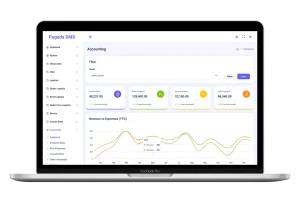
Choosing a DMS development partner is easier when the platform is built around the realities of dealership operations rather than adapted from generic business software. Pagoda Labs DMS brings core dealership functions into one connected platform, helping dealer groups manage sales, inventory, service, CRM, logistics, spare parts, accounting, and reporting from a unified system.
For growing dealer groups, real-time inventory visibility is especially important. Pagoda Labs DMS allows dealerships to track stock across branches, helping teams understand what vehicles are available, on the way, or already committed. This gives sales and management teams a clearer view of inventory without depending on separate spreadsheets or disconnected systems.
The platform is also designed around configurable workflows. Every dealership operates differently, so a DMS should be able to adapt to the way a business manages its sales, service, inventory, and administrative processes. Pagoda Labs DMS focuses on configurable processes rather than forcing every dealership into the same workflow.

Integration and centralized information are equally important. By connecting dealership functions within one platform, Pagoda Labs DMS can help reduce repeated data entry and the operational problems created by disconnected systems. Automation can also support activities such as invoicing, stock alerts, and service reminders, allowing teams to spend less time on repetitive administrative work.
For dealer groups evaluating a long-term auto dealer software vendor, the key advantage is having a DMS that can grow with the business. New branches, changing workflows, larger inventories, and evolving dealership requirements should not require the organization to replace its entire technology foundation.
That makes Pagoda Labs DMS a practical option for dealerships looking beyond a basic feature checklist and evaluating the wider technology foundation behind their dealer management system.
FAQs for Dealers to Choose a DMS Partner
1. What should dealers look for when choosing a DMS development company?
Dealers should evaluate API documentation, uptime commitments, data portability, security, mobile usability, scalability, integrations, backup and disaster recovery, support, and the vendor’s long-term development roadmap.
2. Why is API documentation important for a DMS?
A DMS usually needs to connect with other dealership systems. Clear API documentation makes these integrations easier to build, maintain, and troubleshoot while reducing dependence on the vendor for every integration task.
3. What does data portability mean in a dealer management system?
Data portability means the dealership can access and export its business information in usable formats. This helps protect the dealership from vendor lock-in and makes it easier to migrate information if the business changes platforms in the future.
4. Should a DMS be mobile-first?
Yes. Sales teams, service advisors, technicians, managers, and other dealership employees increasingly need access to information away from a traditional desktop. A mobile-first DMS makes important workflows more accessible across the dealership.
5. What makes a good auto dealer software vendor?
A strong auto dealer software vendor should offer reliable technology, transparent pricing and support, strong security, integration capabilities, data portability, scalable architecture, and a clear plan for improving the platform over time. The vendor should also understand dealership operations rather than simply providing generic business software.
Blogs