The Hidden Cost of Manual Inventory Management in Multi-Location Auto Dealerships
Posted on November 2, 2026
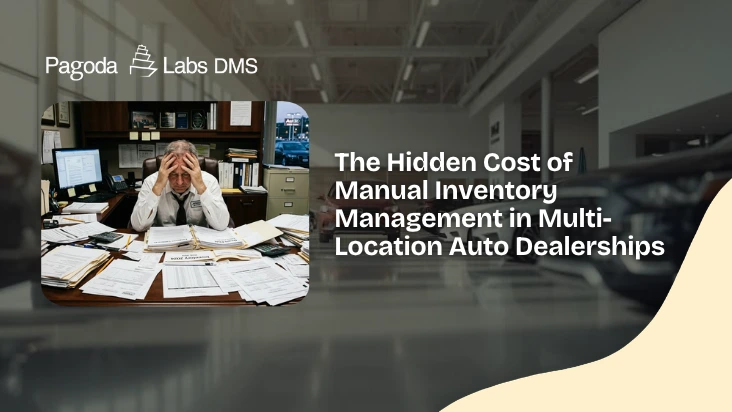
Managing vehicle inventory becomes much harder when a dealership has more than one location. At a single showroom, a spreadsheet may seem like a simple way to track vehicles. Staff can update stock numbers, record sales, and check which cars are available.
But add a second or third location and the problems start to multiply. One showroom may have a vehicle that another showroom needs. A car may be reserved at one location while still showing as available at another. A vehicle may be sitting unsold for weeks while another branch is struggling to meet demand for the same model.
When these decisions depend on spreadsheets, phone calls, messages, and manual updates, dealerships can end up holding too much stock in one location while missing sales opportunities in another.
For a growing dealership group, this can easily create tens of thousands of dollars in unnecessary inventory costs each year.
The Real Cost of Spreadsheet-Based Inventory
The biggest problem with spreadsheets is not the spreadsheet itself. The problem is that spreadsheets depend on people keeping them accurate. Every vehicle needs the correct location, status, price, availability, customer reservation, and movement history. When several people across different locations update this information manually, errors become difficult to avoid.
- A vehicle can be sold at Location A while Location B still sees it as available.
- A vehicle can be transferred but remain listed at the original showroom.
- A customer can reserve a vehicle that another salesperson has already promised to someone else.
These errors may seem small individually, but they can have a direct effect on dealership profits.
An illustrative dealership group with $40,000 to $120,000 tied up annually through unnecessary stock, avoidable carrying costs, missed transfers, and inventory mistakes can quickly see why manual vehicle stock management becomes expensive.
The exact cost depends on the size of the dealership, vehicle prices, financing costs, sales volume, and how long vehicles remain unsold.
The important point is that the cost is often hidden.
Overstocking Is More Than Having Too Many Cars
Overstocking does not always mean a dealership has purchased far more vehicles than it can sell.
It can also mean having the wrong vehicles in the wrong locations.
Imagine a dealership group with three showrooms.
- Showroom A has eight SUVs that have been sitting for more than 60 days.
- Showroom B has customers asking for the same type of SUV, but none are available there.
- Showroom C has several similar vehicles that are selling quickly.
- The dealership already owns the stock it needs.
The problem is that the business cannot see the full picture clearly enough to move the right vehicles to the right location.
Every extra day a vehicle sits unsold can increase the cost of keeping that vehicle in stock. Industry analysis of aged vehicle inventory shows that carrying costs can include financing, depreciation, insurance, and other ownership costs.
This is why a vehicle stock management system needs to look beyond total inventory.
Dealers need to know what is available, where it is, how long it has been there, and where demand exists.
The Missed Cross-Location Transfer
One of the biggest opportunities in multi-location dealership management is moving vehicles between branches based on actual demand.
But manual systems make this harder than it sounds.
A manager may need to:
- Check inventory at another showroom.
- Call or message the other location.
- Confirm that the vehicle is actually available.
- Ask someone to approve the transfer.
- Arrange transportation.
- Update the spreadsheet.
- Tell the sales team that the vehicle is moving.
- Update the receiving location when it arrives.
Every step creates another opportunity for information to become outdated.
By the time everyone agrees on the transfer, the customer may have already found another vehicle.
This is not just an administrative problem.
It is a sales problem.
A Real Pagoda DMS Case: Autoways
Pagoda Labs’ work with Autoways shows what this problem looks like in a real dealership group.
Autoways operates three showrooms in Pokhara, Narayanghat, and Butwal, along with connected service centers. Before using Pagoda DMS, the company relied on spreadsheets, offline messaging groups, and separate accounting software.
Moving stock between showrooms required manual checks through phone calls and email. This could delay vehicle allocation by up to three days.
Sales teams also could not see live stock numbers at other locations. This led to accidental double-booking of specific chassis numbers.
The problem became serious when a customer reserved a high-demand Toyota at the Pokhara showroom, while the same chassis was dispatched from Butwal because the spreadsheet information had not been updated across locations.
The result was a two-week delivery delay and a cancelled customer order. This is the hidden cost of manual inventory management. The dealership did not simply lose time updating a spreadsheet. It lost a customer.
What Happens When Inventory Data Is Shared
Pagoda DMS takes a different approach.
Instead of each showroom maintaining its own version of inventory information, the system provides a shared view of stock across locations.
Pagoda DMS is designed to track vehicle inventory across locations, manage deliveries, control logistics costs, and reduce the time employees spend searching for stock.
This changes how a dealership group can operate.
- A salesperson in Pokhara can see what is available in another showroom.
- A manager can see vehicles currently in transit.
- A reserved vehicle can be marked accordingly so another location does not sell it.
- A transfer can be tracked instead of being managed through a chain of messages.
The goal is simple: everyone works with the same information.
Why Real-Time Stock Matters
A dealership does not need to know what its inventory looked like yesterday.
It needs to know what it looks like now.
This becomes especially important when vehicles are being sold, reserved, delivered, transferred, or prepared for customers throughout the day.
Pagoda DMS provides real-time visibility into stock, sales, invoices, and service activity. Its inventory and logistics tools are designed to track vehicles across locations and manage vehicle movement.
That visibility can help managers answer basic questions without calling another branch:
- Which vehicles are available?
- Where are they located?
- Which vehicles are reserved?
- Which vehicles are in transit?
- Which vehicles have been sitting too long?
- Which location needs additional stock?
Those answers can directly affect purchasing and sales decisions.
How a Vehicle Stock Management System Reduces Overstock
A good vehicle stock management system does more than count vehicles.
It helps dealerships understand how their inventory is moving.
For example, if one branch has several slow-moving vehicles while another branch has strong demand for those models, management can identify the imbalance earlier.
Instead of buying more vehicles, the dealership may be able to use the inventory it already owns.
That can reduce unnecessary purchasing and help vehicles reach customers faster.
The same principle applies to aging inventory.
If managers can quickly identify vehicles that have been sitting too long, they can take action before the cost of holding those vehicles grows.
This could mean moving the vehicle to another location, changing its marketing strategy, reviewing its price, or prioritizing it for sales activity.
The Bigger Problem With Multi-Location Dealership Management
Inventory is connected to almost every other part of the dealership. Sales needs to know what is available. Accounting needs accurate vehicle and transaction information. Service needs to know which vehicles belong to which customers. Management needs accurate reports. Logistics needs to know where vehicles are going.
When each department works with separate information, managers spend time reconciling the differences.
Pagoda DMS connects inventory with sales, CRM, service, accounting, logistics, and other dealership operations through one platform.
That means inventory information does not have to live separately from the rest of the business.
The Results Can Be Significant
The Autoways implementation provides a useful example of what can change when a dealership moves away from manual stock management.
Before Pagoda DMS, showroom-to-showroom vehicle allocation could take three days. After implementation, allocation became real-time.
Weekly administrative work dropped from more than 15 hours per showroom to under two hours.
The case study also reports an approximately 12% inventory tracking error rate before implementation, along with zero duplicate sales after the new system was introduced.
These improvements show why the value of dealership inventory software is not limited to keeping a list of vehicles.
It can reduce manual work, prevent mistakes, improve movement between locations, and give managers better information for daily decisions.
The Move From Spreadsheets to Auto Dealer Inventory Software
Spreadsheets still have their place. They are useful for small tasks, quick calculations, and temporary lists. But they become harder to manage when a dealership has multiple locations and hundreds of vehicle records moving through different stages. At that point, the question is no longer whether a spreadsheet can store the information. It can. The question is whether the spreadsheet can keep the entire dealership working from the same information.
For multi-location dealerships, that distinction matters.
Auto dealer inventory software gives teams a shared place to manage vehicle information instead of forcing each location to maintain its own version of the truth.
Pagoda DMS is built around this connected approach.
It brings inventory, logistics, sales, service, CRM, accounting, and customer information together in one platform.
Better Inventory Starts With Better Visibility
The cost of manual inventory management is rarely found in one large mistake.
It is found in the vehicle that sits too long.The customer who leaves because their reserved car is unavailable. The transfer takes three days. The salesperson who cannot see another branch’s stock. The manager who makes a buying decision using yesterday’s numbers.
Over a year, these small problems can add up to tens of thousands of dollars.
A modern approach to multi-location dealership management starts by giving every location the same view of inventory.
With the right auto dealer inventory software, dealerships can see where every vehicle is, track its movement, understand demand across locations, and make decisions using current information. That is the real purpose of a vehicle stock management system.
Not simply to count cars, but to help dealerships put the right cars in the right place at the right time.
FAQs
1. Why are spreadsheets risky for multi-location dealerships?
Spreadsheets depend heavily on manual updates. When multiple locations update separate files, vehicle availability, reservations, transfers, and sales information can become inconsistent. This can lead to duplicate bookings, missed transfers, and inaccurate stock reports.
2. What is auto dealer inventory software?
Auto dealer inventory software helps dealerships track vehicles, locations, availability, sales, transfers, and other stock information in one system. It gives managers and sales teams a shared view of inventory instead of requiring them to rely on separate spreadsheets.
3. How does a vehicle stock management system help reduce overstock?
It gives managers better visibility into vehicle age, location, availability, and movement. This makes it easier to identify slow-moving vehicles and move them to locations where demand is stronger instead of purchasing additional stock unnecessarily.
4. How does Pagoda DMS support multiple dealership locations?
Pagoda DMS provides centralized inventory and logistics management across locations. Teams can see stock, vehicle commitments, and movement in real time while also connecting inventory with sales, CRM, service, and accounting.
5. Can Pagoda DMS replace dealership spreadsheets?
Pagoda DMS is designed to reduce the need for spreadsheets by bringing dealership operations into one connected platform. Its features include inventory and logistics, sales and CRM, service, parts, accounting, reporting, and multi-location management.
Blogs