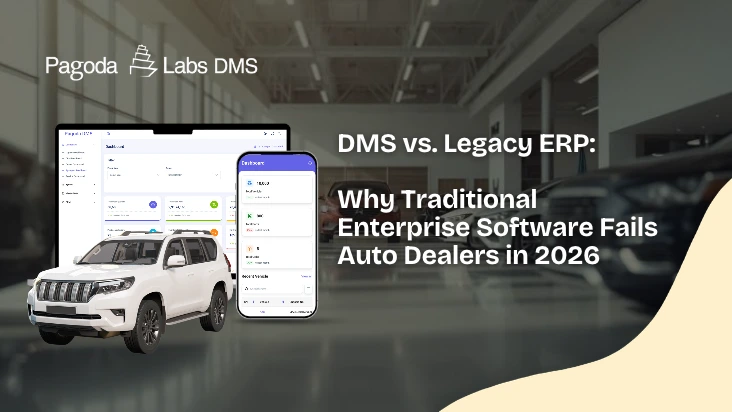
DMS vs. Legacy ERP: Why Traditional Enterprise Software Fails Auto Dealers in 2026
Posted on November 2, 2026
For years, enterprise resource planning software has been the default choice for businesses that need to manage finance, purchasing, inventory, employees, and reporting. For a manufacturing company or large distributor, that approach can make sense. But an automobile dealership is not a generic business.
A dealership has its own way of working. It needs to track individual vehicles, customer enquiries, test drives, reservations, trade-ins, sales, financing, registrations, deliveries, service visits, parts, warranties, and follow-ups. These activities are connected to specific vehicles and customers, not just general business transactions.
That difference is at the heart of the DMS vs ERP for dealers discussion in 2026.
A generic ERP can be customized to handle dealership operations, but every customization adds development work, implementation time, training requirements, and ongoing maintenance. A purpose-built Dealer Management System starts with dealership workflows instead.
This makes the question less about whether an ERP is powerful enough and more about whether you want to spend time and money making general-purpose software behave like dealership software.
ERP and DMS Start With Different Priorities
An ERP is generally designed around the financial and operational needs of a business. Its core functions often include accounting, purchasing, payroll, inventory, procurement, reporting, and other company-wide processes.
A DMS starts somewhere else. It starts with the dealership.
The vehicle, customer, deal, service job, parts transaction, and related financial activity are connected inside the same operating environment. This is important because a single vehicle can move through many stages before and after a sale. Modern DMS platforms are specifically designed to connect functions such as sales, service, parts, accounting, customer information, and inventory.
This difference is easy to overlook when comparing software based on feature lists.
An ERP may have inventory management, for example, but that does not automatically mean it understands dealership inventory. A dealership needs to know which individual vehicle is available, where it is located, whether it is reserved, what customer it is associated with, what has been paid, and what needs to happen before delivery.
The same principle applies to sales and service. A general system can store transactions, but a dealership needs workflows designed around how vehicles and customers actually move through the business.
DMS vs ERP for Dealers: A Practical Comparison
The easiest way to understand the difference is to compare how each approach handles common dealership requirements.
| Requirement | Generic ERP | Purpose-Built DMS |
| Vehicle inventory | Usually requires configuration | Built around dealership stock |
| Vehicle-level tracking | Often needs customization | Core functionality |
| Sales and deal management | Usually requires an added module | Designed for dealership sales |
| Customer follow-up | May require CRM integration | Connected to dealership workflows |
| Service management | Usually requires customization | Built around workshop operations |
| Parts management | General inventory tools | Designed for automotive parts |
| F&I processes | Often requires additional development | Can be part of the dealership workflow |
| Multi-location stock | Available with setup | Designed for dealer groups |
| Dealership reporting | Requires configuration | Built around dealership activity |
| Accounting | Strong | Integrated with dealership activity |
| Implementation | Often larger and more complex | More focused on dealer workflows |
This is why a dealer management software comparison should go beyond asking which platform has more features.
The better question is how much work is required before those features actually fit the dealership.
The Hidden Cost of Customizing an ERP
The biggest problem with using a traditional ERP as the main dealership system is not necessarily the initial software price. It is everything that comes afterward.
If the ERP does not understand a dealership workflow, someone has to change the software or build something around it. That can involve developers, consultants, integrations, custom reports, additional modules, and training.
Over time, these changes become part of the system. When the ERP is upgraded, customized functions may need to be tested or rebuilt. When dealership processes change, the custom software needs to change with them.
This creates a long-term cost that is easy to miss during the initial purchase.
Industry guidance on ERP projects also shows that implementation can become a major part of the total cost. Automotive ERP deployments can involve substantial spending on implementation, integration, data migration, and customization.
For an automobile dealer, this raises a simple question: why build dealership processes into software that was not originally designed around them?
Total Cost of Ownership Matters More Than the License Price
A proper dealer management software comparison should consider the total cost of ownership, not just the monthly or annual software fee.
The total cost can include software licenses, implementation, customization, integrations, data migration, employee training, support, upgrades, reporting tools, and additional software needed to fill gaps.
For example, an ERP may look attractive because the company already uses it for accounting. But if the dealership then needs separate software for vehicle stock, CRM, service, F&I, and sales processes, the original saving can quickly become less meaningful.
There is also the cost of employee time.
If sales staff have to move information between systems, if managers need spreadsheets to understand stock, or if service teams need separate records from sales, the dealership is paying for the gap through additional work.
A purpose-built DMS reduces this problem by bringing dealership functions into one connected system.
Pagoda Labs describes its DMS as a unified platform covering dealership operations, with features including inventory visibility, automation, reporting, and configurable workflows.
Implementation Time Can Change the Entire Project
Implementation is another major difference in the DMS vs ERP for dealers’ decisions.
A traditional ERP implementation can become a large company-wide project. Processes need to be mapped, data needs to be migrated, custom functions need to be developed, integrations need to be tested, and employees need to be trained.
A dealership cannot simply stop selling vehicles while that happens.
A purpose-built DMS has a narrower starting point because its workflows are already based around dealership operations.
That does not mean every DMS implementation is instant. Data migration, employee training, integrations, and configuration still take planning. But the dealership is not starting from the assumption that every automotive workflow must first be designed inside a general business system.
This distinction can make the project easier to manage, especially for dealerships that need to modernize without creating a long period of operational disruption.
Dealer-Specific Modules Make the Difference
The strongest reason to consider a DMS is not that it has more modules.
It is that the modules are designed to work together around dealership activity.
A dealership needs inventory management that connects to sales. Sales needs customer information. Customer information needs to connect with service. Service needs parts. Parts affect invoices and accounting. Management needs reports that bring all of these activities together.
This is where generic ERP software can become complicated.
You may have all the individual functions, but they may not be connected in the way a dealership actually operates.
Pagoda DMS brings dealership functions together across inventory, sales, CRM, service, accounting, logistics, and related operations. Its inventory tools are designed to provide real-time visibility across branches, while its automation features can reduce repetitive administrative work.
The result is a system designed around the dealership rather than a dealership being forced to adapt its processes around the software.
What About Accounting?
This is where ERP software can have a genuine advantage.
Large enterprise groups may have complex accounting, multiple legal entities, international operations, advanced consolidation requirements, or financial processes that go beyond the needs of an individual dealership.
In those situations, an ERP may still have an important role.
In fact, a modern architecture does not always have to be DMS or ERP.
For larger groups, a DMS can handle dealership operations while an ERP handles broader group finance and reporting. Recent industry guidance also describes hybrid DMS and ERP architectures as a practical approach for larger dealer groups with complex financial structures.
The important thing is deciding which system should manage which part of the business.
For many dealerships, using an ERP for general accounting while using a purpose-built DMS for vehicle and dealership operations can be more practical than forcing one system to do everything.
Why Pagoda DMS Fits the Modern Dealership
Pagoda Labs built its DMS around the daily needs of automotive dealerships, particularly businesses operating across markets such as Nepal, South Asia, and other emerging markets.
The platform provides a unified environment for dealership operations, including inventory, sales, CRM, service, accounting, logistics, reporting, and automation. Pagoda also emphasizes real-time inventory visibility across branches and configurable workflows for different dealership requirements.
That approach matters because dealerships are not all identical.
A multi-location dealer may need centralized stock visibility. Another dealership may need stronger service management. Another may need better customer follow-up and reporting.
A DMS should be able to support those workflows without requiring the dealership to build an entire software project around them.
When Should Dealers Choose an ERP Instead?
An ERP is not bad software.
It is simply designed for a different purpose.
A large automotive group with many legal entities, complex financial consolidation, non-automotive subsidiaries, or extensive corporate reporting requirements may benefit from an ERP as part of its technology setup.
But if the main problem is running the dealership, the dealership should have software designed for that job.
The decision becomes clearer when you separate corporate requirements from dealership requirements.
If the business needs group-level financial control, an ERP may be appropriate.
If it needs better vehicle tracking, sales management, service operations, customer management, parts, and dealership reporting, a DMS is built for those needs.
For some larger organizations, the answer may be both.
The Better Auto Dealer ERP Alternative
The biggest mistake in choosing dealership software is assuming that the most powerful general-purpose system will automatically be the best solution.
Power does not remove the need for fit.
A system that requires years of customization, multiple integrations, separate dealership tools, and extensive employee training can become expensive and difficult to maintain.
A purpose-built DMS takes a different approach. It provides the dealership workflows first, then connects the information that those workflows create.
That is why a modern DMS can be a practical auto dealer ERP alternative for dealerships that want to improve operations without turning their software project into a large enterprise transformation.
The goal is not to replace every ERP in every organization.
The goal is to use the right system for the job.
For dealerships, that means software that understands vehicles, customers, sales, service, parts, inventory, finance, and the daily work that connects them.
The Bottom Line
The DMS vs ERP for dealers debate is ultimately about fit, cost, and complexity.
A traditional ERP can manage many important business functions, but adapting it to dealership operations can require additional modules, customization, integrations, and ongoing maintenance.
A purpose-built DMS starts with the dealership and connects its core operations from the beginning.
For a dealership comparing its options in 2026, the best dealer management software comparison should therefore look beyond feature counts and software prices. Consider implementation time, total cost of ownership, employee workload, dealer-specific modules, reporting, scalability, and how well the system matches the way the dealership actually works.
For businesses looking for an auto dealer ERP alternative, Pagoda DMS provides a dealership-focused platform designed to bring these operations together in one system.
FAQs
1. What is the main difference between a DMS and an ERP?
An ERP is general business software designed to manage areas such as finance, purchasing, inventory, and company operations. A DMS is built specifically around automotive dealership processes such as vehicle inventory, sales, customer management, service, parts, and dealership accounting.
2. Is a DMS better than an ERP for an automobile dealership?
It depends on the dealership’s requirements. A DMS is generally a better operational fit when the main requirement is managing dealership activities. Larger dealer groups with complex corporate finance or multiple businesses may use an ERP alongside a DMS.
3. Is a DMS cheaper than customizing an ERP?
The answer depends on the software and dealership size, but total cost should include customization, implementation, integrations, training, support, and ongoing maintenance. A purpose-built DMS can reduce the need to build dealership-specific functions from scratch.
4. How long does it take to implement a DMS?
Implementation time varies based on dealership size, number of locations, data migration, integrations, configuration, and training. A purpose-built DMS can reduce the amount of custom development required because its core workflows are already designed for dealerships.
5. Can Pagoda DMS work alongside an ERP?
Yes. A dealership group can use a DMS for dealership operations while using an ERP for broader financial or corporate requirements. This can be useful for organizations that need enterprise-level financial management without forcing dealership teams to run their daily operations through generic ERP workflows.
Blogs