Connecting Automotive Dealership Operations
Posted on October 30, 2026
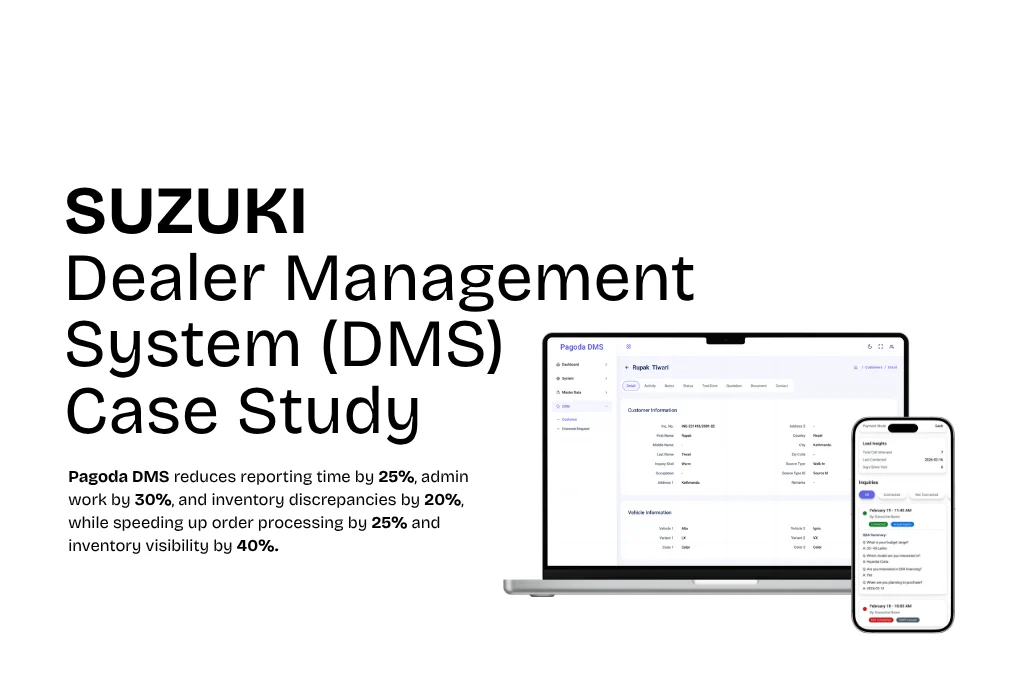
Client: Suzuki (CG Holdings)
Technology Partner: Pagoda Labs Pvt. Ltd.
Solution: Dealer Management System (DMS)
Industry: Automotive, Vehicle Sales, Distribution and After-Sales Service
Company Overview
Managing a growing dealership network requires coordination across vehicle sales, inventory, logistics, customer relationships, and after-sales service. For Suzuki, maintaining consistent information across these functions was essential to overseeing dealership performance and supporting daily operations.
Pagoda Labs implemented a centralized Dealer Management System (DMS) to bring key operational activities into a connected platform. The system helps organize dealership data, improve access to business information, and give management a clearer view of operations across the network.
The Challenge
Before adopting Pagoda DMS, Suzuki’s operations relied on information maintained across spreadsheets, separate reports, and departmental communication channels. Gathering updates from different dealerships and teams required manual coordination, making it difficult to maintain a consistent view of sales, inventory, customer activities, and pending transactions.
As the dealership network grew, these processes created several operational challenges.
- Scattered information: Sales, inventory, and customer records were maintained across different sources.
- Time-consuming reporting: Teams needed to collect, verify, and consolidate information before preparing management reports.
- Limited operational visibility: Management had to rely on updates from individual locations to understand ongoing activities.
- Order tracking difficulties: Following vehicle orders and dispatches could require coordination between multiple departments.
- Inconsistent customer follow-ups: Managing customer inquiries, service reminders, and communication across dealerships required more structured processes.
Suzuki needed a system that could connect these activities, establish consistent workflows, and make operational information easier to access.
The Solution
Pagoda Labs introduced an integrated DMS that connects dealership operations through a centralized platform. It brings together relevant information from sales, inventory, logistics, customer relationship management, service, and reporting, based on the modules deployed.
The system gives authorized users a shared view of recorded transactions and operational activities, helping departments coordinate their work more effectively.
Key capabilities include:
- Centralized dealership management: Organizes sales, customer, and operational records within a common system.
- Dealer and sales monitoring: Supports the review of dealership performance, sales activities, and targets.
- Vehicle and inventory tracking: Helps teams monitor stock availability, vehicle allocation, and recorded inventory movements.
- Order and logistics management: Makes it easier to review order progress, dispatch information, and pending transactions.
- Customer relationship management: Supports customer inquiry tracking, follow-ups, and service-related communication.
- Service management: Provides access to vehicle service histories and service records where the relevant module is enabled.
- Reporting and dashboards: Helps management review operational information without depending entirely on manually compiled reports.
How Pagoda DMS Was Implemented
The implementation focused on bringing Suzuki’s key dealership workflows into one system and establishing a consistent way to record and review operational information.
1. Reviewing Existing Workflows
The process began with identifying how dealership information was being recorded, shared, and reported across the business. Sales, inventory, logistics, customer management, and service workflows were reviewed to understand where manual work and information gaps occurred.
This helped establish which processes needed to be standardized and which data had to be accessible across departments.
2. Configuring the DMS
Pagoda DMS was configured around the relevant operational requirements, including dealership records, sales activities, inventory movements, dealer orders, customer information, and reporting.
The aim was to give each department a structured way to manage its responsibilities while allowing authorized users to access information needed for coordination and oversight.
3. Consolidating Operational Information
Relevant records were organized within the centralized platform to reduce dependence on separate softwares and disconnected reporting sources.
This established a common reference point for reviewing dealership activities, subject to the data migrated and the modules included in the implementation.
4. Connecting Departmental Workflows
The relevant modules were connected to support the flow of information between sales, inventory, logistics, service, and customer management.
For example, teams could review recorded vehicle stock and order information when coordinating dealer allocations. Customer and service records could also support follow-ups and service-related communication.
5. Enabling Reporting and Management Visibility
Reporting tools and dashboards provided management with a more structured way to review available operational information.
Instead of depending entirely on reports collected separately from each location, authorized users could consult centralized records to review sales activities, inventory status, and pending transactions.
6. Supporting Adoption and Ongoing Use
The final stage involved incorporating the system into day-to-day operational processes. Employees needed to record and update information consistently so that reports remained useful and teams could rely on the system when coordinating activities.
The ongoing value of the DMS depends on accurate data entry, consistent use across participating locations, and regular review of operational performance.
Results and Impact
1. Improved Operational Efficiency
Centralizing operational records reduces the need to maintain and reconcile multiple versions of the same information. Employees can access relevant records through established workflows, while management can review available data through standardized reports.
This helps reduce routine administrative work and makes it easier to identify pending activities that require attention.
Key improvements:
- Less repetitive data entry and record maintenance.
- Easier access to dealership information.
- More organized reporting processes.
- Better coordination between departments and locations.
2. Greater Control Over Dealership Performance
Pagoda DMS provides management with a more consistent way to review sales activities and dealership operations. Information recorded across participating locations can be used to compare performance, review progress against targets, and identify areas requiring follow-up.
Key improvements:
- More consistent dealership performance reporting.
- Better visibility into sales activities and targets.
- Easier identification of pending transactions.
- Improved oversight of branch-level operations.
3. Better Inventory and Distribution Visibility
Tracking vehicle movement across a dealership network requires accurate records of stock, allocation, orders, and dispatches. Pagoda DMS helps bring these records into a centralized workflow, making it easier for authorized teams to review vehicle status and coordinate distribution activities.
Key improvements:
- Clearer visibility into recorded vehicle stock and movements.
- Easier tracking of dealer orders and dispatch status.
- Better coordination between inventory and logistics teams.
- More informed vehicle allocation decisions.
4. More Organized Customer Management
Customer inquiries, ownership details, service histories, and follow-up activities are important throughout the vehicle ownership journey. The CRM capabilities within Pagoda DMS help teams maintain customer records and organize communication more consistently.
Key improvements:
- Better access to customer information and interaction history.
- More systematic tracking of inquiries and follow-ups.
- Support for scheduled service reminders.
- Improved continuity in customer communication.
These processes also give dealerships a stronger foundation for encouraging repeat service visits and maintaining long-term customer relationships.
5. Faster Access to Business Insights
Management decisions depend on having reliable information available when it is needed. With centralized records and structured reporting, Suzuki can review relevant operational data through a common platform, subject to the information captured and the user’s access permissions.
Key improvements:
- Less dependence on manual report consolidation.
- Easier comparison of operational performance.
- Faster identification of information gaps and pending activities.
- Better-informed planning across sales, inventory, and service operations.
In Numbers
The impact of Pagoda DMS can be measured across dealership operations, inventory management, reporting, and customer engagement.
25% less time spent on routine reporting
Reduce the time required to compile dealership reports and consolidate operational data.
30% less manual administrative work
Cut repetitive data entry, record maintenance, and coordination across departments.
40% faster access to vehicle and inventory status
Help teams identify recorded stock levels, vehicle allocation, and dispatch status more quickly.
25% faster dealer order processing
Reduce delays caused by manual coordination between order management, inventory, and logistics teams.
20% fewer inventory discrepancies
Improve consistency between recorded stock movements and inventory records.
30% faster customer follow-ups
Help dealership teams identify pending inquiries and service reminders through centralized customer records.
100% centralized operational visibility
Bring recorded sales, inventory, logistics, and customer information into one platform for participating dealerships, subject to system coverage and data completeness.
Overall Outcome
Pagoda Labs DMS has given Suzuki a centralized framework for managing key dealership activities and reviewing operational information across the business.
By connecting sales, inventory, logistics, customer management, and reporting, the system supports more consistent processes and better coordination between teams. Employees can access relevant records more easily, while management gains a clearer basis for monitoring performance and identifying operational issues.
The implementation also provides a foundation for measuring improvements in administrative efficiency, order processing, inventory accuracy, and customer engagement over time.
Case Studies